Induction or Ceramic Cooker: Which Is Better?
7 min read
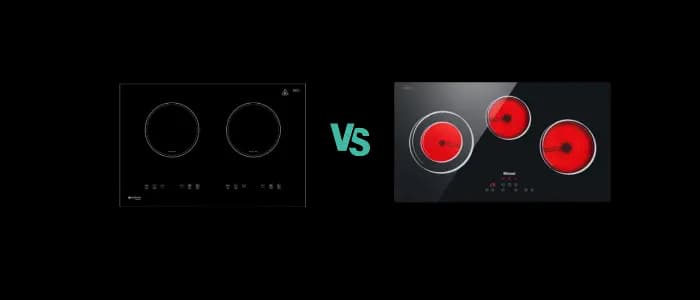
Induction and ceramic hobs look almost identical: a flat sheet of black glass with touch controls. Underneath, they could not be more different. An induction hob heats the pan itself with a magnetic field. A ceramic hob heats a coil under the glass and lets the heat travel up into the pan. That one difference decides the speed, the running cost, the safety, the noise and the cookware you can use.
This guide compares the two on everything that matters in a Malaysian kitchen, answers the questions people ask most, and ends with a plain recommendation.

Quick Answer: Induction or ceramic, which is better?
Induction is the better cooker for most homes: it boils faster, wastes less energy, keeps the glass cooler and responds instantly. Ceramic wins on price and on cookware, because it heats any pan. Choose ceramic if your budget is tight or you are attached to non-magnetic pots. Choose induction for everything else.
How each one makes heat
An induction hob has a copper coil under the glass. Switch it on and the coil produces a magnetic field. Put a pan with a magnetic base on top and the field induces a current in the base of the pan, and that current heats the metal. The glass itself is not heated; it only picks up warmth from the pan sitting on it.
A ceramic hob has a radiant coil, a ribbon element that glows red under the glass. The coil heats the glass, and the glass heats the pan. It works like a traditional electric plate hidden under a smooth surface.
Induction vs ceramic at a glance
| Induction | Ceramic | |
|---|---|---|
| How it heats | Magnetic field heats the pan directly | Element heats the glass, glass heats the pan |
| Time to boil 1 litre | About 3 to 4 minutes | About 6 to 8 minutes |
| Energy reaching the pan | Around 85 to 90% | Around 65 to 70% |
| Response to a setting change | Instant | Slow, with lag both ways |
| Surface after cooking | Warm, cools in minutes | Hot for 15 to 30 minutes |
| Cookware | Magnetic base only | Any flat-bottomed pan |
| Noise | Faint hum or fan on high power | Silent |
| Price | Higher | Lower |
| Safety | Pan detection, no red-hot surface | Residual heat indicator, glass stays hot |
Speed and energy efficiency
Induction transfers most of its energy straight into the pan, so water boils in roughly half the time a ceramic hob takes and the kitchen stays cooler while it does it. A ceramic hob loses a share of its heat into the glass and the air around it. Over a year of daily cooking that gap shows on the electricity bill, though for a household that cooks lightly it is small.
Temperature control and cooking feel
Turn an induction zone down and the pan stops heating at once, which makes it easy to catch a sauce before it splits or bring a rolling boil down to a simmer. Ceramic lags. The coil keeps glowing after you lower the setting, and it takes a minute to come back up when you raise it. Some cooks like that steady, forgiving heat for stews and porridge; anyone used to gas will find it slow.
Cookware: what cannot be cooked on induction
Induction only works with a pan whose base a magnet will stick to. That rules out:
- Glass and Pyrex pots
- Ceramic and stoneware pots
- Aluminium pans, unless they have a bonded steel plate in the base
- Copper pans
- Some older stainless steel with a non-magnetic base
Put a non-magnetic pan on an induction hob and nothing happens: the zone shows an error or simply stays cold. No power is used and nothing is damaged. Cast iron, enamelled cast iron, carbon steel and most modern stainless steel all work. A ceramic hob heats any of them, which is its strongest argument.
Safety: is ceramic or induction safer?
Induction is the safer of the two. The glass only warms from contact with the pan, so a hand placed on the surface a minute after cooking will not be burned. Most zones switch off automatically when the pan is lifted away. Ceramic glass stays hot long after the element goes off, which is why every ceramic hob has a residual heat indicator that glows until the surface cools. Both types usually offer a child lock and an auto-off timer, but check the model.
Lifespan
A well-made ceramic hob lasts 10 to 20 years because there is little in it beyond the element and the glass. Induction hobs carry more electronics and typically last 10 to 15 years. Both are outlived by a good gas hob, and on both the glass is the part most likely to fail, usually from a dropped pot rather than age.
Noise
Ceramic hobs are silent. Induction hobs can hum or buzz at high power, especially with lightweight pans, and most run a cooling fan you may hear on a long boil. It is not loud, but it is there.
Cleaning and spills
Both wipe clean because both are flat glass. The difference is what happens to a spill. On a ceramic hob, sugar or sauce that lands on the hot glass bakes on within seconds and needs a scraper. On induction the glass is cooler, so most spills wipe away with a cloth. Our guide to removing white spots from glass stove tops covers the baked-on kind.
Cost
Ceramic hobs are cheaper to buy, often by a wide margin for the same size and zone count. Induction costs more upfront and may need new pans. Against that, induction uses less electricity per meal. For a household that cooks every day the running cost narrows the gap over a few years; for one that cooks occasionally the ceramic hob stays cheaper overall.
Two questions people always ask
Why do chefs not use induction? Most restaurant kitchens run on gas because a flame can be judged by eye, a wok can be tossed over it, and it takes any pan. Induction is spreading in professional kitchens for its speed and for how much cooler it keeps the room, but tradition and the wok still favour gas. If that is your cooking too, read our guide to induction versus gas in Malaysia.
Why does my induction hob take so long to boil water? Almost always the pan. A thin, warped or slightly non-magnetic base couples poorly with the coil and the hob throttles back. A small pot on a large zone does the same. Use a flat, heavy, magnetic pan matched to the zone size and induction is the fastest hob there is.
Should I get ceramic or induction?
Choose induction if you want:
- Fast boiling and instant control
- Lower electricity use
- A surface that is safe to touch soon after cooking
- Spills that wipe off rather than bake on
Choose ceramic if you want:
- The lower purchase price
- To keep your existing aluminium, copper or glass cookware
- Slow, steady, silent heat for soups and stews
- The look of a glowing element
VATTI sells both kinds. The VH-IC9-LA pairs a 2,300 W induction zone with a 2,200 W ceramic zone on one glass top, so you can try each side of this comparison in one hob. The ER3601T and the five-zone ER5902T are ceramic throughout. And if wok cooking is the heart of your kitchen, a gas hob with a high-output burner still does that job best; the VATTI gas hobs are built around it, with glass tops that clean like a ceramic hob. Our guides to infrared gas burners and to ceramic versus infrared cookers cover that side of the decision.
Induction vs ceramic FAQs
Is a ceramic hob the same as a glass hob? Not quite. Both use glass-ceramic tops, but "ceramic hob" means the radiant kind with an element under the glass, and an induction hob uses the same glass with a coil instead. Our article on ceramic versus glass cooktops untangles the names.
Can I use my old pans on induction? Hold a fridge magnet to the base. If it sticks firmly, the pan works. If it slides off, it will not heat.
Does an induction hob use a lot of electricity? Less than a ceramic hob for the same cooking, because more of the energy reaches the food. A high-power zone can draw 2 kW or more while boiling, but for a shorter time.
Which is easier to clean? Induction, because the cooler glass stops spills baking on. Both are far easier than a gas hob with pan supports.
Final thoughts
Induction is the better hob for speed, efficiency, safety and cleaning. Ceramic is the better hob for price and for cookware freedom. Decide which of those two lists matters more in your kitchen and the choice is made. The VATTI cooker hob range has induction, ceramic and gas side by side, so you can compare the zones and burners model by model.