
How to Measure the Suction Power of a Kitchen Hood
8 min read
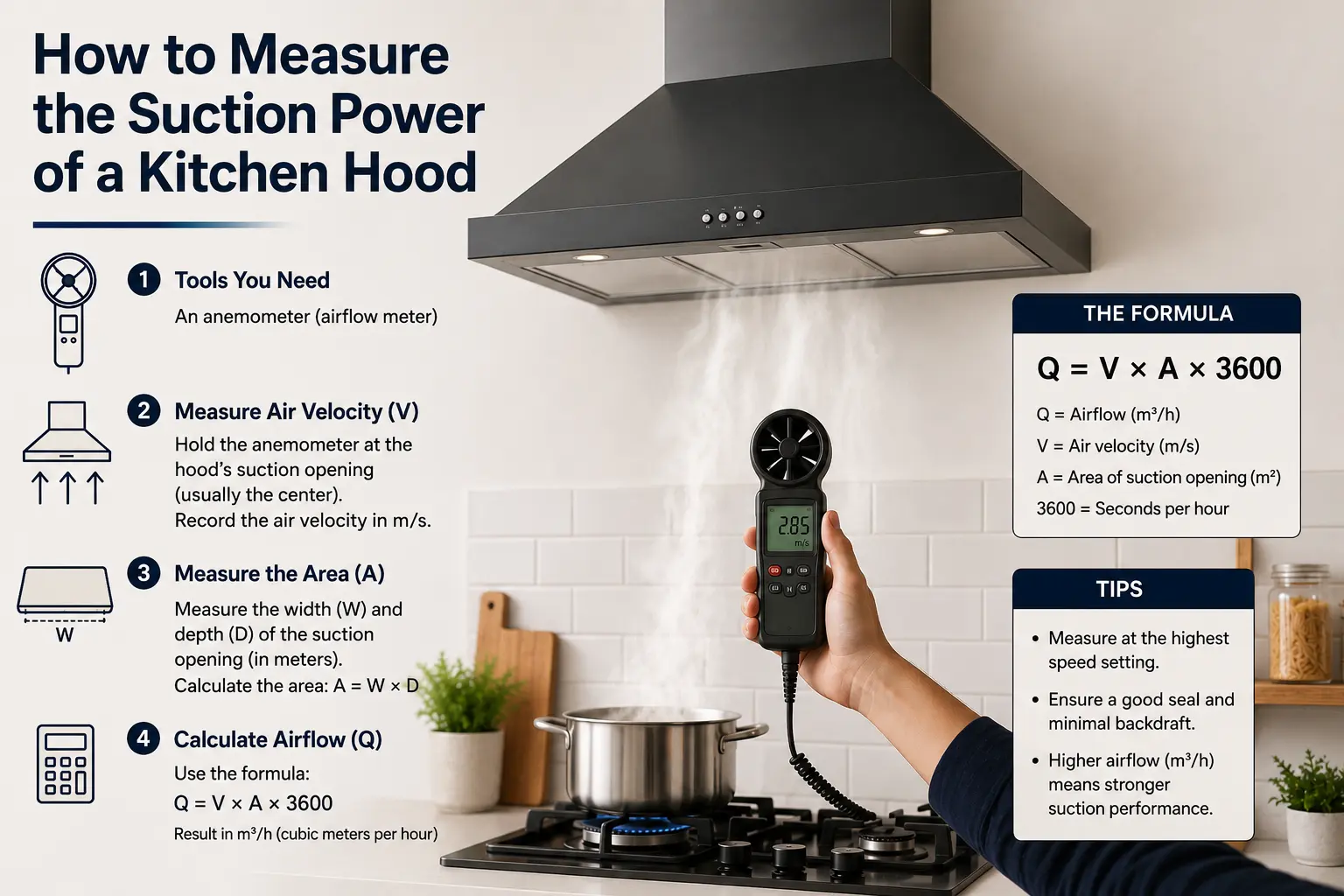
Walk into any kitchen appliance showroom in Malaysia and you will see hoods marketed with big, bold suction numbers : 1500 m³/h, 2500 m³/h, sometimes even higher. They sound impressive, but most shoppers have no idea what these figures actually mean, how they are measured, or whether a bigger number guarantees a better hood. The truth is, suction power is not a single number . It is a combination of two technical specs working together. Understanding what they mean and how to measure them is the difference between buying a hood that actually clears your kitchen and one that just sounds powerful on paper. This guide explains exactly how kitchen hood suction power is measured, what numbers you should look for, and how to test your hood’s performance at home.
Quick Answer: How to Measure the Suction Power of a Kitchen Hood?
Kitchen hood suction power is measured using two specs: airflow (m³/h) and air pressure (Pa) . To work out the airflow your kitchen needs, multiply your kitchen volume (length × width × height in metres) by 10 to 15 air changes per hour . A standard Malaysian kitchen of 3m × 4m × 2.7m needs around 324 to 486 m³/h minimum , but heavy wok cooking calls for 1500 to 2500 m³/h . High-rise condos should also prioritise high air pressure ( 800Pa or more ) to push smoke through long shared ducting.
What Does “Suction Power” Actually Mean?
When people say “suction power,” they usually mean how strongly a kitchen hood pulls smoke and air away from your cooktop . But strength is not a single measurement. A hood’s real performance comes from two specs working together: how much air it can move and how forcefully it can move that air through resistance like filters, ducting, and bends.
In Malaysia, this matters more than most homeowners realise. High-rise condos often use long, shared service ducts , and landed homes have varying ducting paths to exterior walls. A hood with strong airflow on paper can still underperform if it does not have the pressure to push air through these real-world conditions. Both numbers, working together, are what define true suction power.
The Two Key Metrics You Need to Know
Two measurements tell you almost everything you need to know about a kitchen hood’s suction performance. Both are clearly listed on every reputable manufacturer’s spec sheet:
Airflow (m³/h)
Airflow is measured in cubic metres of air per hour . It tells you how much air the hood can move when running at maximum speed. The higher the number, the more air the motor can shift through the system. Most modern Malaysian-market hoods fall between 800 m³/h on entry models and 2500 m³/h on premium high-suction models . Airflow is the single most quoted spec on product pages, but on its own it does not tell the full story.
Air Pressure (Pa)
Air pressure is measured in Pascals (Pa) and tells you how forcefully the hood can push air through resistance. Filters, long duct runs, bends, and external weather conditions all create resistance that reduces airflow. A hood with high static pressure (800Pa and above) can maintain strong suction even under those conditions. Vatti’s premium hoods reach up to 1300Pa , which is specifically designed for high-rise installations where shared ducting can run several metres long. If you live in a condo, this number matters even more than airflow.
How to Measure the Suction Power Required for Your Kitchen?
Before you start comparing models, you need to know how much suction your specific kitchen actually needs. There is a simple formula used industry-wide: multiply your kitchen volume by the number of air changes per hour you want . For kitchens, the standard recommendation is 10 to 15 air changes per hour , depending on cooking intensity.
- Measure your kitchen. Note the length, width, and ceiling height in metres. For example, a typical Malaysian apartment kitchen might measure 3m × 4m × 2.7m .
- Calculate the volume. Multiply length × width × height. Using the example above: 3 × 4 × 2.7 = 32.4 cubic metres .
- Apply the air change rate. For light cooking, multiply by 10. For heavy cooking, multiply by 15. So 32.4 × 10 = 324 m³/h minimum for light use , and 32.4 × 15 = 486 m³/h for heavier use .
- Add a Malaysian cooking buffer. These baseline figures assume mild Western-style cooking. For wok stir-frying, deep-frying, and grilling, multiply by 3 or 4 to account for the smoke and oil load. That same 32.4m³ kitchen used for daily wok cooking realistically needs around 1300 to 1500 m³/h .
This is why most premium Malaysian-market hoods sit at 1500 m³/h or higher . The formula reflects Western cooking; local cooking patterns demand more.
How Manufacturers Test and Report Suction Power?
Not every manufacturer measures airflow the same way, which is why two hoods rated “2000 m³/h” can perform very differently in real kitchens. There are two main testing methods:
- Unrestricted airflow. The motor is tested without filters, ducting, or any installation conditions. It measures the theoretical maximum, not what you will actually experience at home . This is the most commonly quoted figure in marketing because it gives the biggest number.
- IEC standard airflow. A more realistic benchmark. The hood is tested with filters and a representative ducting setup. This figure is typically 20 to 40 percent lower than unrestricted airflow , but reflects real-world performance much more accurately.
When comparing two models, check whether the airflow is unrestricted or IEC-rated . A 2000 m³/h IEC-rated hood typically outperforms a 2200 m³/h unrestricted hood. If the spec sheet does not specify, ask the seller. Reputable brands publish both figures, including Vatti’s full kitchen hood lineup , which lists both airflow and air pressure for every model.
How to Test the Suction Power of a Hood at Home
You will not be able to measure exact m³/h or Pa values without lab equipment, but you can run quick at-home tests to confirm your hood is performing as advertised:
- The tissue test. Turn the hood to its highest setting. Hold a piece of tissue paper close to the underside of the filter. It should stick firmly without falling . If it drops away easily, your hood is either underpowered or the filter is clogged.
- The incense or steam test. Light a stick of incense (or boil a kettle to release steam) directly under the hood. Switch the hood on full and watch how the smoke or steam moves. It should be drawn up cleanly and disappear within seconds , not drift sideways or hover in the air.
- The smoke clearance test. After a heavy stir-fry, time how long the hood takes to fully clear visible smoke from the kitchen. A well-sized hood should clear most visible smoke within 30 to 60 seconds . If it takes several minutes, the suction is too weak for your cooking style.
- The side-leak check. Place your hand near the edge of the hood while it is running. You should feel air being drawn upward. If you feel air spilling sideways or backwards , the hood is either undersized for your hob or has an air pressure issue.
Recommended Suction Power for Malaysian Kitchens
These benchmarks are based on real Malaysian cooking habits and kitchen layouts. Use them as a starting point when comparing models:
| Cooking Style | Recommended Airflow (m³/h) | Recommended Air Pressure (Pa) |
|---|---|---|
| Light cooking (occasional stir-fry, mainly boiling and reheating) | 800 to 1000 | 400 to 600 |
| Average family wok cooking | 1000 to 1500 | 600 to 800 |
| Heavy daily Asian cooking (deep frying, grilling, daily wok) | 1500 to 2500 | 800 to 1300 |
| High-rise condo (any cooking style with long shared ducting) | 1200 to 2000 | 1000 to 1300 (prioritise this) |
For example, the Vatti Triple Intake T-Type V937 delivers 2500 m³/h airflow and 1050Pa air pressure, which suits heavy daily Asian cooking. For smaller condo kitchens with lighter use, the Vatti Slim Series V996 offers balanced suction in a compact form factor. The Vatti Aetheris V929 sits in the middle for average family use with the added benefit of PM2.5 air purification.
Other Factors That Affect Real-World Suction Performance
Even with the right airflow and air pressure on paper, real-world performance can vary widely depending on installation and design factors. The spec sheet only tells half the story:
- Ducting length and bends. Every metre of duct and every 90-degree bend reduces effective airflow. Two bends can cut performance by 40 to 50 percent if not planned carefully.
- Filter type and condition. Baffle filters offer better airflow than mesh, but both clog up with oil over time. A grease-loaded filter can halve your hood’s real-world suction.
- Mounting height. Hoods mounted too high (above 75cm from the hob) lose significant capture efficiency, regardless of motor power.
- Hood-to-hob width matching. A 60cm hood over a 90cm hob lets smoke escape sideways. The hood should be at least as wide as your hob , ideally wider.
- Motor type. Brushless Direct Current (BLDC) motors deliver more consistent suction over time than conventional motors, with less performance loss as they age.
- Hood engineering and capture area. A well-designed hood with a wide canopy and smart airflow management can outperform a higher-spec hood with poor design.
For a deeper breakdown of how all these factors come together, the Vatti kitchen hood overview covers the full picture of what matters in real Malaysian kitchens, not just the headline numbers.
Final thoughts
Once you know what to look for, comparison shopping becomes simple. If you would like help matching the right model to your kitchen, our team is happy to walk you through the options. Message us on WhatsApp for a free consultation or a personalised recommendation based on your kitchen size and cooking style.


